

Finding a Chinese Alternative to a Schneider Circuit Breaker
How to read a Schneider breaker designation and decide whether a Chinese LV or MV equivalent can genuinely substitute it, field by field.
Key takeaway
Whether a Chinese breaker can substitute for a Schneider device turns on a fixed set of parameters: rated current In and frame size, Icu and Ics at the actual system voltage, utilisation category, trip-unit type and setting range, pole and neutral configuration, mounting and busbar geometry, auxiliary contacts and shunt or undervoltage releases, communication, and the scope of the type test certificate; each field must be compared individually rather than matched code to code.
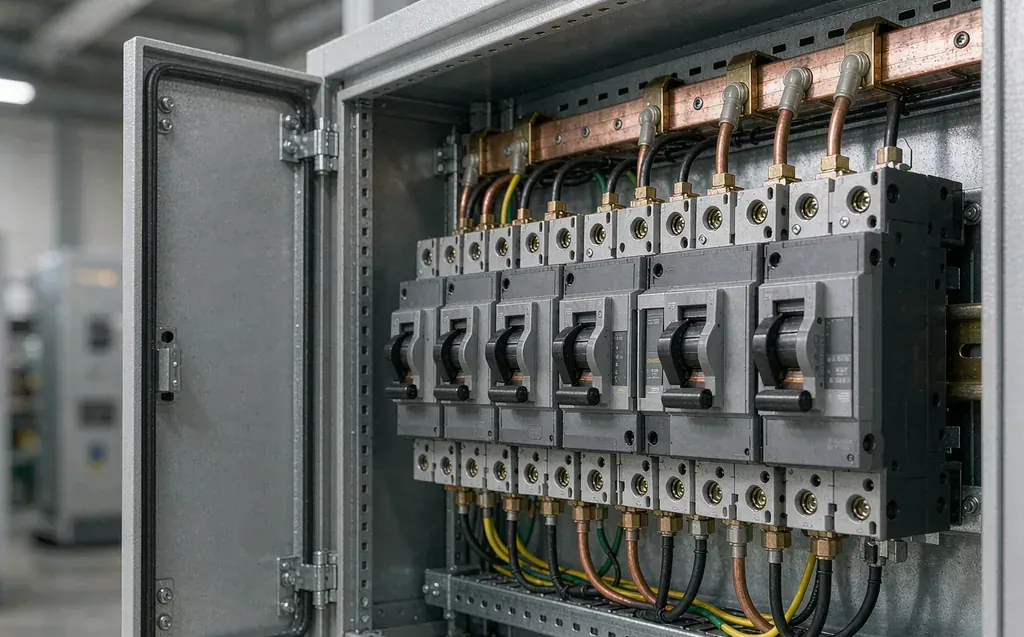
Most sourcing conversations about Schneider breakers do not start from a blank page. There is already a designation in the tender, a reference on the single-line diagram, or a spare-parts list naming what the plant was built with. The real question is narrower than whether Chinese gear is any good: it is whether a specific Chinese breaker can occupy that slot without changing how the installation behaves under fault. That is an engineering question with finite answers, and most of them are printed on the datasheet you already hold.
Reading the designation, and the fields it resolves into
A Schneider breaker reference — on a moulded-case device, an air circuit breaker, or a medium-voltage vacuum unit — is a compressed ordering code, not a specification. It bundles a frame family, a trip unit, a pole count, a breaking-capacity class, a connection style and a list of options into one string. You cannot match a string against a string. What you can do is resolve the code into the fields it encodes, and match those.
Rated current (In) and frame size. In is the current the device is designed to carry continuously at a stated ambient temperature, and it is fixed by the trip unit and the current path. Frame size is a different thing: it is the physical and thermal envelope of the family, and it sets the maximum rating that family can reach, the busbar pitch, the terminal geometry and the mounting footprint. Two breakers with the same In can sit in different frames, so two apparently “equivalent” devices can be anything but interchangeable once you try to bolt them in. Read In and frame together, and read the ambient at which In is quoted: a rating at 40 °C and one at 50 °C are not the same device.
Rated voltage, and the capacity to break at it. Icu and Ics mean nothing without a voltage attached. The rated ultimate short-circuit breaking capacity (Icu) is the highest fault current the device is tested to break, and after that test sequence it is not required to remain in service. The rated service short-circuit breaking capacity (Ics) is the value it must survive and still be usable, typically expressed as a fraction of Icu. Both are declared at a stated voltage, often one figure at 415 V and a lower one at 690 V, so a datasheet quoting a single Icu number describes its best case, not your case.
Trip unit and protection functions. This decides whether the breaker protects the installation or merely the cable. A thermal-magnetic trip unit gives a fixed or lightly adjustable thermal element plus a fixed magnetic element. An electronic trip unit gives adjustable ranges for overload (long-time), short-time delay, instantaneous and often ground fault, and usually carries the metering and communication. The generic functions — overload, short circuit, earth fault — are well established and comparable across manufacturers; the adjustable ranges, curve shapes and setting steps are not, and those differences govern coordination with the rest of the board.
Utilisation category, poles and connection. IEC 60947-2 draws a line between category A devices, which have no intentional short-time delay, and category B devices, which do and are therefore the ones intended to be selective with downstream devices. Pole configuration (three-pole, four-pole, or three-pole plus a switched or protected neutral) and whether the neutral is rated at full or partial current is another field that is routinely skipped, and it starts to matter the moment the load is a mix of single-phase and three-phase. Connection style — fixed, plug-in or withdrawable, front or rear access — is a mechanical contract rather than an electrical one.
Type test evidence. A datasheet states intent; a type test report states what was actually tested, at which voltage, current, pole count and configuration, and its scope is itself part of the specification.
Mapping the parameters that decide interchangeability
| Parameter | What to read | What must match |
|---|---|---|
| Rated current, frame and poles | In at the quoted ambient; the frame the device sits in; pole and neutral configuration | In at least equal within a frame whose footprint, busbar pitch and pole arrangement suit the compartment |
| Rated voltage and breaking capacity | Icu and Ics, each with the voltage it is declared at | Ics at your actual system voltage covers the prospective fault current, with margin |
| Utilisation category | Category A or B per IEC 60947-2 | Category B where the design relies on short-time-delay selectivity downstream |
| Trip unit type and settings | Thermal-magnetic or electronic; type of protection functions; adjustable ranges and curve shape | The same protection functions, setting ranges covering the values you require, comparable time-current curves |
| Mounting, busbar and terminals | Fixed, plug-in or withdrawable; terminal type, busbar pitch, rear-connection depth, door cutout | Physical fit in the existing compartment, or a defined adaptor and cable plan |
| Auxiliaries and releases | Auxiliary contacts, shunt trip, undervoltage release, coil voltages and contact arrangement | The same functions, at a control voltage the existing scheme can supply and a wiring scheme it can accept |
| Communication | Whether status and metering are exposed, and over which protocol and gateway | Protocol, data set and mapping compatible with the monitoring system already reading the board |
Where the equivalence breaks down
Icu versus Ics at the voltage you actually run. The most common false match is a device whose headline Icu looks generous until you read it at your system voltage, or whose Ics is a small fraction of that Icu. A device that clears one fault and is then scrap meets a different requirement from one returned to service. Where the design assumes selectivity and re-closing, Ics governs.
The trip-unit curve, not just the trip-unit type. Two electronic trip units can both offer long-time, short-time, instantaneous and ground-fault protection and still coordinate differently, because curve shapes, delay bands and setting steps are not harmonised between manufacturers. The same applies to a thermal-magnetic substitution: the thermal band and the magnetic threshold decide where it trips relative to a motor’s starting current and a downstream device’s instantaneous setting.
Mechanical geometry. Frame size, busbar pitch, terminal type, rear-connection depth, door cutout and handle position are set by the original compartment. A substitute that is electrically correct can still be undeliverable because it does not fit, cannot be cabled, or cannot be racked in the space provided. Geometry is the exception that most often decides a project after the electrical comparison has passed.
Auxiliaries, releases and communication. Auxiliary contacts, shunt trips and undervoltage releases are usually ordered separately and carry their own coil voltages and contact configurations. If a replacement keeps the main device but changes the control-circuit voltage or the release type, the change propagates into the wiring, the interlocking and the safety logic. Communication is the same story a layer up: status and metering exposed under one protocol may not map cleanly onto the monitoring system already reading the existing devices.
Certificate scope. A type test certificate covers a defined configuration — voltage, current, poles, trip unit, enclosure. A certificate valid for one rating does not automatically cover the rating you are ordering, or an enclosure or accessory that was not part of the test.
Discrimination with the rest of the installation. A breaker is never judged alone. It has to coordinate with the upstream device and with every downstream device in the fault path, in both overload and short-circuit regions, and is usually required to withstand the full prospective fault current for the duration of the upstream device’s clearing time. That coordination is a study, not a datasheet comparison, and a substitution invalidates the study done for the original.
Keep it or switch it
Keep the original brand, or an exact like-for-like, when any of the following holds: the breaker belongs to an assembly type-tested as a whole and the certificate does not travel with the individual device; the fault level makes Ics, cascading and short-time withstand the governing design limits; the design relies on published discrimination tables between matched upstream and downstream devices; the compartment only accepts the original frame; the control and protection scheme depends on accessory functions and a communication map documented for the existing device; or a regulatory authority has already accepted the original.
A Chinese equivalent is defensible when the parameters are compared field by field rather than code to code: rated current and frame are at least equal and the geometry is compatible; Ics at the actual system voltage covers the prospective fault current with margin; the utilisation category, trip-unit function and setting range match the design intent; the auxiliary, release and communication functions are either reproduced or deliberately replaced as a documented change; and a type test report covering the configuration you are buying can be produced. Where those conditions hold, the substitution is an engineering decision that can be written down and defended. Where any of them is assumed rather than checked, it is a risk transfer wearing the clothes of a saving.
SpecSourcing runs a free 48-hour screen on a single supplier and returns a go / hold / walk signal. A paid Spec Match tier takes the breaker reference you already hold, reverse-engineers the parameters behind it and shortlists manufacturers that can meet them. The free screen is a signal about one supplier, not an approval of a substitution; the substitution decision remains with your engineering team and your approving authority.
Common questions
Can a Chinese moulded-case breaker replace a Schneider one?
What is the difference between Icu and Ics, and which one matters?
When should a buyer keep the original brand?
Brand and model names are trademarks of their respective owners, used here for identification only. SpecSourcing is not affiliated with, authorised by, or endorsed by any of these manufacturers.