

Replacing a Siemens MV Switchgear Lineup with a Chinese Equivalent
How to read a Siemens MV switchgear reference and single-line diagram, which parameters a Chinese equivalent must match, where equivalence fails when extending an existing board, and when keeping the original brand is the right call.
Key takeaway
Replacing a Siemens medium-voltage switchgear panel with a Chinese equivalent is decided by the single-line diagram rather than the brand: rated voltage and insulation level, main busbar rated current, rated short-time and peak withstand current, internal-arc classification (IAC) with its test current, duration and accessible sides, IP degree, loss-of-service-continuity category (LSC1 / LSC2A / LSC2B), vacuum circuit-breaker type, CT/VT ratios and classes, relay interfaces, and the busbar and cable-termination geometry must all match on the conservative side; equivalence is usually defensible for a new, self-contained lineup backed by type-test evidence covering that configuration, and usually fails when extending an existing switchboard on mechanical interfaces.
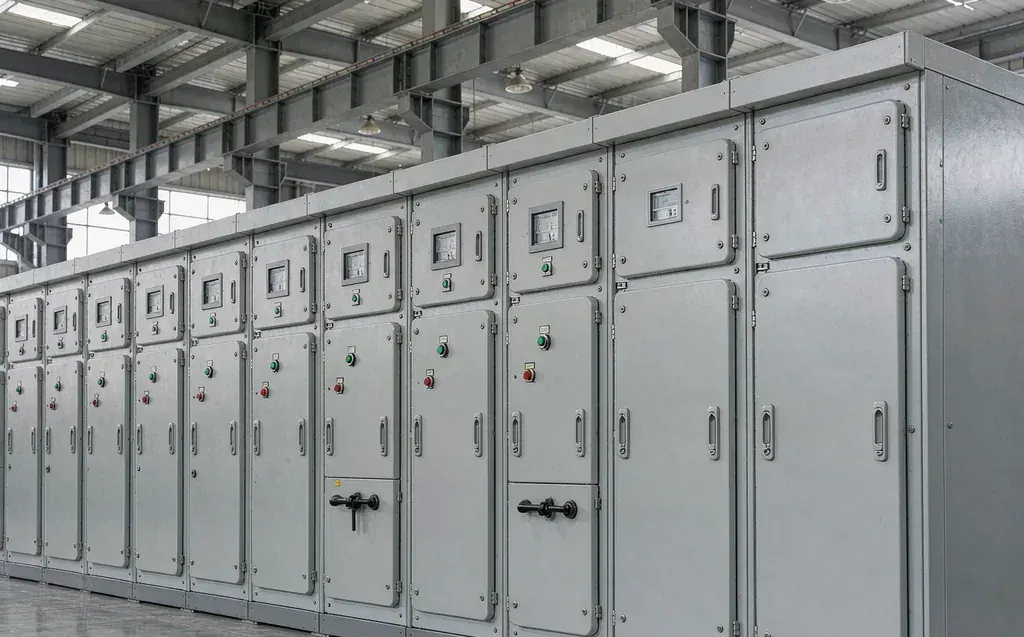
A Siemens medium-voltage switchgear lineup is rarely bought as a single panel. It is a busbar system that grows, and the second question an EPC buyer asks, right after “can a Chinese panel do this?”, is “can it be bolted onto what I already have?” The honest answer is that a Chinese equivalent can substitute for a Siemens panel in a new, self-contained lineup far more often than it can extend an existing one, and the difference between those two cases is almost entirely about interfaces rather than about the circuit-breaker.
What the designation and the single-line diagram actually tell you
A switchgear type designation is a compact label, not a specification. Its letters and digits usually encode the product family, the insulation medium, the voltage class and sometimes the breaker technology, so the designation tells you which design vocabulary the panel speaks. It does not tell you what the panel will do on your busbar.
The real specification sits on the single-line diagram and in its schedules. Before asking any Chinese manufacturer for a quotation, extract these fields and restate them as your own requirement list:
- Rated voltage and insulation level. Rated voltage (U_r) with the lightning-impulse and power-frequency withstand values sets the dielectric design of the whole panel, not just a nameplate entry.
- Rated normal current. The main busbar rating and each feeder rating set conductor cross-section, current-transformer ratio and the ventilation of the enclosure.
- Rated short-time withstand current and peak withstand current. These set the thermal and dynamic duty the busbar and breaker must survive, and for how long.
- Internal arc classification (IAC). The classification letters come with a test current, a duration and the accessible sides they cover: front, lateral, rear. The scope is a safety decision, not a decorative label.
- Degree of protection and loss of service continuity. The enclosure IP rating (IEC 60529) plus the compartmentalisation category (LSC1, LSC2A or LSC2B) which describes how much of the board stays live when one compartment is opened.
- Circuit-breaker type. Vacuum is now the norm in this voltage class; note the technology, the operating mechanism and its auxiliary supply.
- CT, VT and relay interfaces. Ratios, accuracy classes and burdens for the instrument transformers, and the protection and control relay interfaces: protocols, binary I/O and the terminal-numbering convention at the wiring blocks.
- Busbar and cable-termination geometry. Busbar material, cross-section and joint position; cable-compartment depth, the number and size of cable entries, and the direction of cable egress.
Every one of these is a constraint. A quotation that matches five fields and silently differs on the sixth is the quotation that stops your project at commissioning.
Mapping the key parameters
A substitution is defensible when each parameter matches on the conservative side: the Chinese panel equal to or above the Siemens requirement, never below. Read the Siemens documents as the requirement, then read the Chinese offer as the response.
| Parameter | What to read | What must match |
|---|---|---|
| Rated voltage and insulation level | U_r plus lightning-impulse and power-frequency withstand, on the nameplate and in the type-test report | Same voltage class, and withstand equal or higher |
| Main busbar rated current | Rated normal current of the busbar and of each feeder | Busbar rating ≥ the requirement; feeders matched per circuit |
| Short-time and peak withstand current | Rated short-time withstand current with its duration, and rated peak withstand current | At least equal on both, for the same duration |
| Internal arc classification | IAC letters with test current, duration and accessible sides | Same class and scope, at least the same test current and duration |
| Loss of service continuity | LSC1 / LSC2A / LSC2B, compartment by compartment | At least the same partition level; LSC2B where the original was LSC2B |
| IP degree | Enclosure IP rating, and where it applies | Equal or higher, and applying to the same surfaces |
| Breaker, CT/VT and relay interfaces | Breaker type, CT/VT ratios and classes, relay protocol and I/O | Vacuum breaker; CT/VT ratios and classes met; protocol compatible |
Where the equivalence breaks down
Even when the parameter table lines up, these are the areas where Chinese equivalents most often fail, not on capability but on interface.
Busbar and cable-termination geometry. A busbar system is a mechanical interface before it is an electrical one. Busbar material, cross-section, the orientation of the tee-offs, the height of the joint faces above the floor and the bolt pattern all have to line up if a new panel is to join an existing board. Cable compartments are harder still: the depth available behind the panel, the number and diameter of the entry plates, the direction of cable egress and the room to bend a large conductor inside the box are all fixed by the original design.
Internal-arc classification scope. IAC is not a single pass-or-fail label; it is a set of tested conditions: the arc current, its duration, which sides are protected and which remain accessible. A panel classified for front access only is not the same product as one classified for front, lateral and rear. If your arc-flash study or safety case assumes rear accessibility under a given classification, the scope has to match, not just the designation.
Relay and CT/VT interfaces. The protection philosophy is a document, not a component. If the original scheme uses a particular relay family with a particular protocol and a particular terminal numbering, the replacement has to speak the same language to your SCADA and to the protection scheme that surrounds it. CT and VT secondary ratings must match in ratio and in accuracy class, or the existing settings no longer mean what they meant. This is usually solvable, but it is a design task rather than a catalogue lookup.
Dimensional envelope and cable entry. Footprint, height, depth and entry position are fixed by the room and the trench you have already built. A taller panel may not clear a low ceiling or a busbar duct; a deeper cable box may not clear the trench edge; a left-hand cable entry cannot be swapped for a right-hand one without reworking the trench. These constraints rarely appear on a data sheet in the form in which they bite on site.
Test-certificate scope and spares. Type tests are performed on a representative design, not on every unit, while routine tests are performed on each unit. Confirm that the type-test evidence covers the configuration you are actually buying (the same voltage, busbar current, arc class and compartment layout), and that routine-test reports will be supplied per panel. Then look at spares: a Chinese panel introduces a second supply chain, and the breakers, relays and mechanical interlocks your maintenance team already stocks may no longer fit.
Keep it or switch it
These are conditions to weigh, not a recommendation. Keep the original brand, or at least keep the original line, when:
- The project extends an existing switchboard. The cost of solving a busbar and cable-entry interface (engineering, adaptor panels and the site risk of a mismatch discovered during installation) is often larger than the saving on the panels themselves.
- A client standard names the manufacturer, or a framework agreement or utility type-approval list excludes alternatives.
- The protection and control scheme depends on a specific relay family, and migrating it is a real cost.
- The quantity is very small relative to the effort of proving equivalence.
- The board is in service and you need a single spare panel under time pressure.
A Chinese equivalent is defensible when:
- The lineup is new, self-contained and designed as a whole, not joined to an existing board.
- The key parameters on the single-line diagram are fully specified, and the manufacturer holds type-test evidence covering that configuration.
- You can accept a second supply chain and want a documented spares plan.
- You control the interface design and can hold the manufacturer to it.
- There is enough schedule to review drawings and witness routine tests.
Neither list is a promise. They are simply the questions that decide the outcome.
SpecSourcing runs a free 48-hour screen that returns a go / hold / walk signal on whether a given Chinese supplier can cover a stated requirement. The paid Spec Match tier reverse-engineers the parameters from your Siemens single-line diagram and shortlists manufacturers whose documented type tests cover that configuration. Neither tier asks you to take equivalence on trust: the output is a parameter-by-parameter comparison you can check yourself.
Common questions
Can a Chinese MV switchgear panel replace a Siemens panel?
What evidence should I ask a Chinese switchgear manufacturer for?
Does a matching type-test certificate make the replacement equivalent?
Brand and model names are trademarks of their respective owners, used here for identification only. SpecSourcing is not affiliated with, authorised by, or endorsed by any of these manufacturers.