

Perkins Generator Equivalent: Sourcing a Chinese-Built Genset
A practical guide for buyers holding a Perkins generator-set reference: which datasheet parameters actually constrain interchangeability, where an equivalent set can fail, and when substituting is defensible.
Key takeaway
A generator set is defined by a datasheet envelope, not by its engine brand, so interchangeability turns on duty rating (prime, standby or continuous) under ISO 8528, kVA and kW at a stated power factor (commonly 0.8), voltage and frequency (50 or 60 Hz), engine speed (1500 or 1800 rpm), alternator type and excitation, insulation class and temperature rise to IEC 60034, voltage regulation and transient response, enclosure acoustic level, control-panel and synchronising capability, fuel consumption across load, and the emission stage required by the destination market; because the alternator, controller and enclosure are separately chosen, a Chinese-built set on a different engine can meet the same duty and rating envelope as a Perkins-referenced set, and the keep-or-switch decision then depends on certification scope, type-test evidence, and spares and service reach.
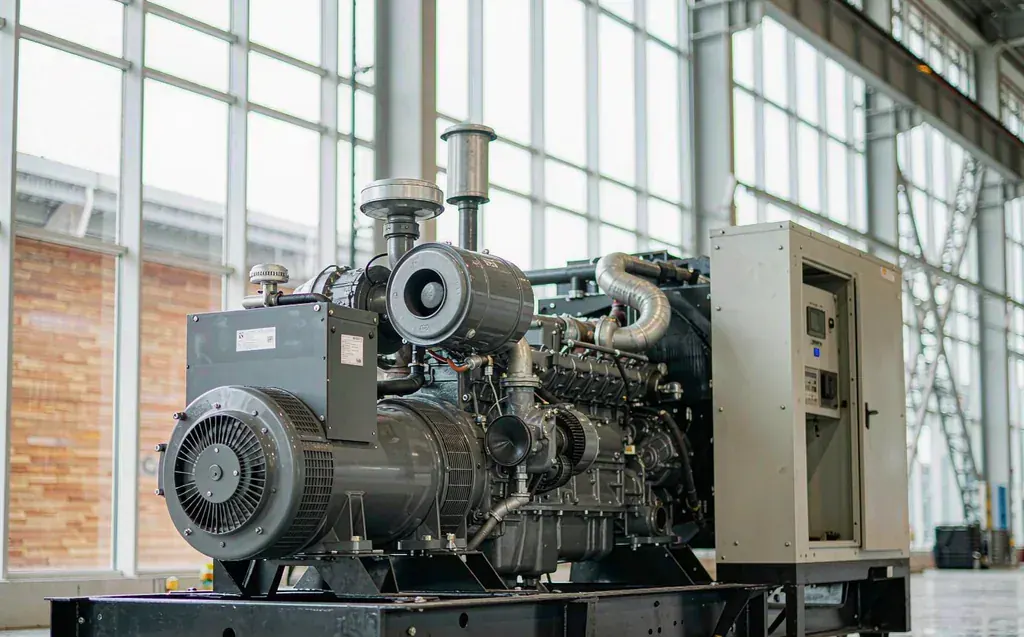
A buyer who holds a Perkins generator-set reference is usually asking one question: can a Chinese-built set do the same job? The honest answer starts with the datasheet, not the engine badge. What has to match is the duty and rating envelope the set was specified for, and the engine is only one of the choices that produce it.
What a generator-set datasheet actually tells you
A generator set is not an engine. It is an engine, an alternator, a coupling, a control panel, a cooling package, a base frame and an enclosure, assembled and rated together. The datasheet describes that assembly: a rating type, an apparent-power figure at a stated power factor, a voltage and frequency, a speed, an acoustic level, and a set of behaviours under load. The engine brand appears on the sheet, but it is not the sheet.
This matters because the engine is chosen first and the rest of the set is chosen around it. The alternator can be a self-excited machine with an automatic voltage regulator or a separately excited one; it can be wound to one insulation class and temperature rise or another; it can be sized generously or to the edge. The controller can be a basic auto-start module or a paralleling unit. The enclosure can be an open skid or a sound-attenuated canopy with an acoustic rating at a stated distance. Two sets built on engines from the same family can land in quite different performance envelopes, and two sets built on engines from different makers can land in the same one.
So when a buyer asks whether a Chinese-built set is “equivalent” to a Perkins-referenced set, the useful translation is narrower: does the candidate set satisfy every constraint the reference set satisfied? That is a parameter question, answered from the datasheet, the rating definition and the test evidence, not from the engine name. ISO 8528 defines generating-set ratings and performance classes; ISO 3046 covers the engine’s own performance declarations; IEC 60034 covers the rotating machine. Those are the vocabularies to read the sheet in.
Mapping the key parameters
The table below is the short list. If a candidate set fails any row your site depends on, it is not equivalent for that site, however close the kVA figure looks.
| Parameter | What to read | What must match |
|---|---|---|
| Duty rating | Whether the stated output is a prime, standby or continuous rating, and how the maker defines each | The rating type, not only the number. A standby rating and a prime rating are different envelopes and are not interchangeable |
| kVA / kW at power factor | Both figures, and the power factor they are stated at (commonly 0.8) | The kVA at the same power factor. Comparing kW alone hides the apparent-power limit that sizes cables, switchgear and protection |
| Voltage, frequency, phase | Rated voltage and connection, and whether the set is 50 Hz or 60 Hz | The site’s distribution voltage, phase and frequency. A set built for one frequency is not a fallback for the other |
| Engine speed | The rated speed at the rated frequency (1500 rpm for 50 Hz, 1800 rpm for 60 Hz at four poles) | Speed consistent with the required frequency; a low-speed set does not deliver a high-frequency supply |
| Alternator and excitation | Alternator type, excitation method, insulation class and temperature rise to IEC 60034 | Insulation class, temperature rise and excitation behaviour, which drive motor starting and short-circuit response |
| Voltage regulation and transient response | Steady-state regulation band, and the dip and recovery when a block load is applied | The envelope your largest motor start and your sensitive loads can tolerate |
| Enclosure, acoustics and emissions | Canopy or open type, ingress protection, sound level at a stated distance, and the declared emission stage | The acoustic limit and IP rating the site allows, and the emission stage the destination market requires at import |
Three rows deserve a sentence rather than a cell. Duty rating is the row buyers skip most often: a standby set is intended for limited hours and no sustained overload, so a set sold on a standby figure may not sit at that output continuously. Fuel consumption should be read as a curve across load, consumption per hour at part load rather than a single headline number, because the figure that matters is the one at your expected load, not at full load. And the control panel is a design choice in its own right: whether the set can parallel and synchronise, and whether its protections and communications match the site’s electrical scheme, is not settled by the engine.
Where the equivalence breaks down
Alternator and excitation. The engine turns the shaft; the alternator makes the electricity. Excitation method and insulation class determine how the set behaves during a large motor start, how it recovers from a fault, and how much of its rating it sustains in a hot ambient. Two sets with the same engine and different alternators are not the same set, and the alternator is the easiest part to change when a price has to be hit.
Controller and compatibility with the site. A set that must parallel with the mains or with other sets needs a controller with the right synchronising, load-sharing and protection functions, and communications the site’s SCADA or building management system can read. A set that is perfectly adequate standalone can be unusable in a synchronised scheme, and that is a controls question, not an engine question.
Enclosure and acoustic limits. Sound level is quoted at a stated distance and under stated conditions. If the site has an acoustic limit (a residential boundary, a hospital, a night-time restriction), the canopy and attenuation package have to meet it. The enclosure also carries the ingress protection and the cooling airflow, and a tighter canopy is a harder thermal problem.
Emission stage for the destination market. Emission requirements are set by the market the set is imported into, and by the requirement in force for that year. A set compliant for one destination is not automatically compliant for another. The declared emission stage is a datasheet line to verify, and it rests on the engine’s certification for that stage.
Certification and type-test scope. A certificate is worth exactly what its scope covers. What matters is whether the type test or certification applies to the specific set — this engine, this alternator and this configuration. Under the standard and for the market you need. A certificate for a different configuration, or a different standard, does not transfer. Ask for the scope, not the logo.
Spares and service network. An equivalent set is only equivalent if it can be maintained. Check who stocks filters, injectors, sensors and controllers in your country, what the lead time is, and whether local technicians have worked on that engine and that controller. Spares reach is a commercial fact about your market, and it belongs in the comparison rather than in the afterthought column.
Keep the reference or switch to an equivalent
There is no general answer, only conditions. Keeping the original engine brand is usually the right call when a governing specification or a client’s approved-vendor list names the engine brand, so a substitute would need a formal deviation; when the warranty or service agreement you rely on is tied to that brand and that set; when your own field team, tooling and spares inventory are built around it; or when the emission and certification evidence you need for your market is held specifically for that set and re-qualifying another would cost more than the price difference.
Substituting an equivalent is usually defensible when the specification constrains the duty and the numbers (rating type, kVA at power factor, voltage, frequency, speed, transient behaviour, acoustic level, emission stage) rather than the engine badge; when the candidate set’s datasheet meets each of those constraints with the margin your load profile needs; when the type-test or certification evidence you need exists for the exact configuration offered; and when service and spares for the candidate engine are reachable in your market within an acceptable lead time.
Two conditions cut the other way in both cases. Do not treat a matching engine brand as evidence that a set matches: the alternator, controller and enclosure can still be wrong for your duty. for your duty. Do not treat a matching kVA figure as evidence either; kW at a power factor, a rating type and a transient envelope can all disagree with the number on the front of the brochure. If a supplier cannot state the rating definition or produce type-test evidence, the lower price is carrying risk that has not been priced.
SpecSourcing runs a free 48-hour screen on one supplier and returns a go / hold / walk signal, a judgement on whether that supplier’s line plausibly covers your parameters, not a score. The paid Spec Match tier reverse-engineers the parameters from your reference datasheet and shortlists manufacturers whose line actually covers them. The exercise is run on the set and its evidence, not on the engine badge.
Common questions
Can a Chinese-built generator set replace a Perkins-powered set?
Does the engine brand alone tell me whether a set will work on my site?
What should I send with a sourcing request?
Brand and model names are trademarks of their respective owners, used here for identification only. SpecSourcing is not affiliated with, authorised by, or endorsed by any of these manufacturers.