

Finding a Chinese Equivalent for a Hitachi MV/HV XLPE Power Cable
How an overseas EPC or utility buyer should read a Hitachi MV/HV XLPE cable specification and judge whether a Chinese cable construction genuinely meets the same specification and test regime.
Key takeaway
A Hitachi MV/HV XLPE cable can be substituted by a Chinese construction only when the conductor material, IEC 60228 class and compaction, XLPE insulation compound and thickness, semicon screen type (bonded or strippable), metallic screen or sheath type and cross-section, armour, oversheath material and IEC 60332 flame grade, rated voltage U0/U(Um), temperature ratings, short-circuit withstand, bending radius, drum length and the test regime (routine, sample, type, prequalification) all match on the exact construction named in the type-test report, and the destination utility's acceptance list admits the manufacturer; equivalence is a same-specification, same-test-regime finding, not an identity or brand claim.
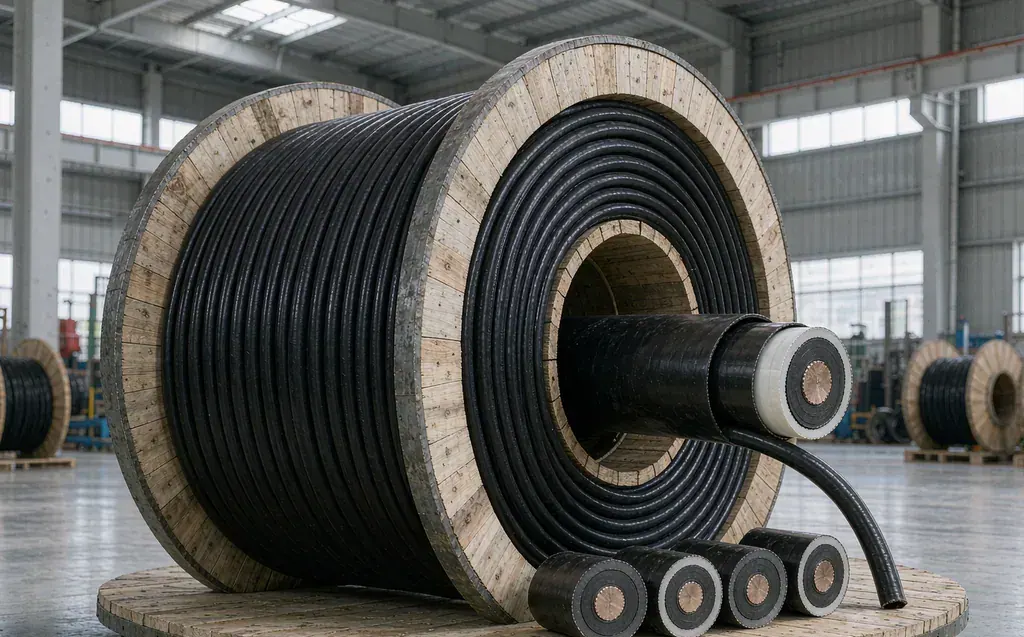
Most requests start the same way. A buyer has a Hitachi MV or HV XLPE cable specification, a drawing, and a budget that assumes a Chinese factory can hit it. The real question is not whether a Chinese cable looks similar. It is whether a specific factory can deliver a construction that meets the same specification and passes the same test regime, and whether your destination utility will accept it. What follows is what actually constrains interchangeability, and where a “close enough” answer turns expensive.
What the datasheet and the type-test report actually tell you
The cable datasheet is a design statement, not a warranty. Each line narrows the set of factories whose standard construction can meet it without a special run. Read it field by field.
Conductor. Material (copper or aluminium), cross-sectional area, and class per IEC 60228 (class 1 solid, class 2 stranded, class 5 flexible). MV and HV cables normally use compacted class 2 stranded conductors. Conductor shape and compaction matter beyond current rating: they set the cable diameter, the electric stress at the screen, and the jointing ferrule geometry. A compacted stranded conductor and a segmental or Milliken conductor of the same nominal area are not interchangeable at accessory level.
Insulation. Cross-linked polyethylene (XLPE), nominal thickness, and compound type. Thickness follows the design stress and the applicable standard table (IEC 60502-2 for MV, IEC 60840 and IEC 62067 for HV). Identical nominal thickness on two datasheets is necessary but not sufficient if the reference specifies a particular compound family, for example a tree-retardant grade.
Semicon screens. Conductor screen and insulation screen, and whether the insulation screen is bonded or strippable. This is where many equivalence claims quietly fail, because a strippable screen and a bonded screen call for different jointing technique and different accessories.
Metallic screen or sheath. Copper wires, copper tape, lead sheath, or aluminium laminate; and the cross-section, which sets the earth-fault and short-circuit duty carried by the screen. Two cables with the same insulation can still diverge at an earth-fault coordination check if the metallic screen cross-section differs.
Armour. Steel tape, steel wire, aluminium wire, or unarmoured. Armour type drives mechanical protection, minimum bending radius, and gland selection.
Oversheath. Material (PVC, PE, LSZH) and flame-propagation grade under IEC 60332. A single-cable flame test and a bunched-cable test are different requirements, and projects usually name one of them specifically.
Rated voltage U0/U(Um). For example 8.7/15 kV, 12.7/22 kV, 19/33 kV, 64/110 kV. This is not a range to approximate. U0/U(Um) has to match, because it fixes the insulation thickness and the test voltages.
Temperature and current rating. Continuous conductor temperature, typically 90 °C for XLPE, and short-circuit conductor temperature, typically 250 °C. The continuous current rating per IEC 60287 depends on the installation (buried, in air, in duct, trefoil, flat spaced), so a rating quoted without its installation basis is not comparable.
Short-circuit withstand. Conductor short-circuit current for a stated duration, and screen short-circuit current. Both are compared against the system fault level and the protection clearing time, and both must be met, not partly met.
Bending radius. Stated as a multiple of the overall diameter, and different for armoured and unarmoured, single-core and three-core. It fixes the pulling route and the joint bay geometry.
Drum length. The manufacturing length, decided at the factory and not changeable afterwards. If the standard drum does not match the span between joints on your route, you get extra joints, extra accessories, and extra failure points.
Test regime. Routine tests on every drum: conductor resistance, partial discharge, voltage withstand. Sample tests on a frequency basis. Type tests once per design, for example under the relevant IEC 60840 or 62067 clause. Prequalification tests for HV, which are a separate long-duration regime. These are not interchangeable, and a type test on one construction is not evidence for another.
Mapping the parameters that decide interchangeability
The table below is the checklist we run against a reference specification. “What must match” is the minimum; where the destination utility is stricter than the standard, the utility wins.
| Parameter | What to read | What must match |
|---|---|---|
| Conductor | Material, area, IEC 60228 class, shape and compaction | Material and class; area equal or accepted by the utility after a design check; compaction compatible with the accessories |
| Insulation and screens | XLPE compound, nominal thickness, bonded or strippable semicon | Same voltage-class design; thickness per IEC 60502-2 or 60840/62067; same screen type so jointing is compatible |
| Metallic screen or sheath | Copper wire, copper tape, lead, or aluminium laminate; cross-section | Type and cross-section that meet or exceed the earth-fault and short-circuit duty |
| Armour and oversheath | Armour type; oversheath material; IEC 60332 flame grade | Armour meets the mechanical duty; oversheath and flame grade meet the project and utility specification |
| Rated voltage and temperature | U0/U(Um); continuous and short-circuit conductor temperature | U0/U(Um) exact; temperature ratings equal or higher |
| Current and short-circuit rating | IEC 60287 rating with its installation basis; fault current for duration | Rating calculated on the same installation basis; fault withstand meets the system level |
| Test regime, drum length, bending radius | Routine, sample, type, prequalification; drum length; minimum bend radius | Same regime on the same construction; drum length covers the joint span; bend radius suits the route |
Where the equivalence breaks down
Certificates have to name the exact construction and voltage class. A certificate that says only “XLPE cable to IEC 60502-2” proves almost nothing. It must name the conductor size and class, insulation thickness, screen type, armour, oversheath and flame grade, and the voltage class, and it must point to a type-test report for that exact construction. If the certificate is generic and the report covers a different size, you hold no evidence for the cable you are buying.
The test regime and witnessing are separate conditions. Routine tests are per drum and should come as factory test certificates. Type tests are once per design. HV prequalification is a long-duration regime of its own. If the destination utility expects to witness routine or type tests, or expects an independent laboratory, an unwitnessed in-house report may be rejected at review. Settle that before award, because re-testing after manufacture is slow and costly.
Accessories and jointing are half the system. A cable that meets the cable specification can still fail at the joint if the semicon screen type, conductor shape, or insulation diameter differs from what the accessory maker’s kits are designed around. Terminations and joints are usually qualified as a system with a specific cable construction, so the accessory supplier has to confirm compatibility; the cable maker’s statement alone is not enough.
Drum lengths and delivery are fixed early. Drum length is set at manufacture. If your route needs long spans, confirm the factory can produce them, and check drum size and weight against your pulling equipment and access roads.
The destination utility’s acceptance list often binds first. Many utilities and EPC owners keep an approved-vendor or approved-product list. A cable that meets the specification but is not on that list can still be rejected at inspection regardless of test results. Read the acceptance regime before you read the price.
Keep it or switch it
There is no universal answer, only conditions. Run these against your project.
- If the destination utility maintains an approved-product list and the Chinese construction is not on it, keeping a listed manufacturer is usually the lower-risk path unless you are prepared to fund the qualification programme.
- If the cable sits on a safety-critical or hard-to-access route (a river or road crossing, a dense duct where a joint failure means excavation), the cost of one failure outweighs the price saving, and the equivalent has to be fully qualified before it is considered.
- If the specification is fully standard (a common voltage class, standard class 2 copper conductor, standard oversheath, standard drum length) and the factory can show a type-test report on exactly that construction, an equivalent is defensible.
- If the accessory system is already qualified for a particular cable construction and cannot be changed, match the cable to the accessories rather than the other way round.
- If your programme has float for a sample test or a witnessed routine test, the switch becomes more defensible. Without that float, an unverified substitution puts the commissioning date at risk.
- If the price gap is small, the qualification cost and the schedule risk usually erase it.
Switching a cable is a qualification exercise, not a purchase. SpecSourcing runs a free 48-hour screen that returns a go / hold / walk signal on one supplier against the equipment you hold and the destination you are delivering to. Where several parameters move at once, the paid Spec Match tier reverse-engineers the parameters from the specification you hold and shortlists the manufacturers whose line genuinely covers them.
Common questions
Can a Chinese cable be a direct replacement for a Hitachi cable?
What must a type-test report name for an equivalent to be accepted?
Who decides whether the equivalent is acceptable?
Brand and model names are trademarks of their respective owners, used here for identification only. SpecSourcing is not affiliated with, authorised by, or endorsed by any of these manufacturers.