

How to Tell a Real Chinese Equivalent from a Relabelled One: A Buyer's Method
How to verify whether a unit offered as a Chinese equivalent of a Western brand is a genuine drop-in substitute, using the reference unit's own documents and a six-step method.
Key takeaway
To verify a claimed Chinese equivalent, build a parameter matrix from the reference unit's own rating plate, datasheet, GA and wiring drawings and test reports across electrical ratings, physical envelope, interfaces, accessories and environment; treat fit as an interface problem before a ratings problem; confirm the entity that manufactures the product class rather than the trading office; require type-test certification that names the exact construction, voltage class and model; price the whole envelope including accessories, spares, documentation, witness testing, warranty and freight; then decide keep-or-switch against written criteria. The three failure modes are ratings that match while the interface does not, a certificate that does not cover the ordered model, and a supplier with no production line for the product class.
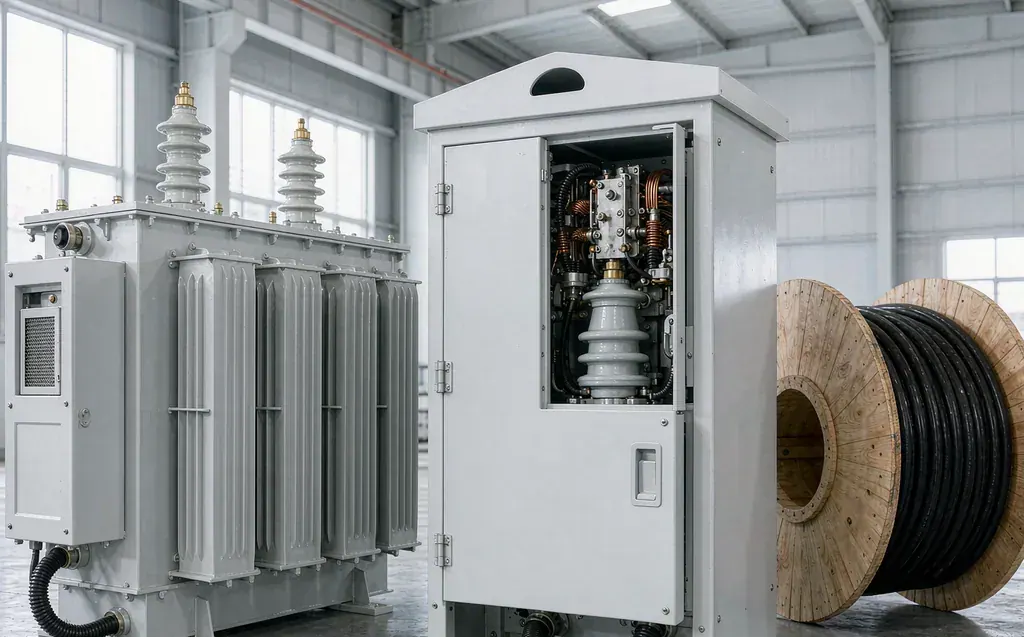
When you are offered a unit described as “the same as” a Western brand you already run, the useful question is not whether the claim is sincere. It is whether the claim can be checked, row by row, against documents you already hold. This article sets out a repeatable method for doing that: build a parameter matrix from the reference unit’s own paperwork, separate “same function” from “same fit”, verify who actually manufactures the product, read the certification evidence, price the whole envelope, and then decide with explicit criteria. The method is brand-agnostic and applies to transformers, switchgear, breakers, cable, generating sets and inverters alike.
Build the parameter matrix from the reference unit’s own documents
Do not start from the offer, the quotation, or the catalogue. Start from the unit you already operate, the reference unit, and from its own documents: the rating plate, the nameplate data sheet, the general arrangement (GA) drawing, the single-line and wiring diagrams, the routine test report, and, where available, the type-test certificate.
Read them in that order. The rating plate gives you the headline ratings. The datasheet gives you the ratings the plate has no room for. The GA drawing gives you the envelope. The wiring diagram gives you the interfaces. The test report tells you what was actually measured, on which unit, at which works.
Then build a matrix with one row per parameter and one column per candidate. Group the rows into five families:
- Electrical ratings. Rated voltage and voltage class, rated current, frequency, short-circuit withstand current, peak withstand, impulse withstand level, power rating, temperature-rise class, insulation class, degree of protection (IP), and the short-time and breaking ratings that define the device.
- Physical envelope. Overall dimensions, mass, mounting or pad arrangement, cable-entry positions, busbar arrangement, floor loading, lifting points, and clearances to adjacent equipment.
- Interfaces. Primary connections (bolt pattern, conductor size, termination type), secondary and control wiring, current and voltage transformer ratios and burden, communication protocol, auxiliary supply voltage and capacity, and the form factor of any relay or module that must drop into an existing compartment.
- Accessories. Cooling, fans, heaters, thermostats, surge arresters, interlocks, operating handles, indications, labels, and any item that is “included” in the reference unit but optional in the offer.
- Environment and duty. Ambient temperature range, altitude, seismic requirement, pollution degree, humidity, corrosive atmosphere, duty cycle, expected service life, and maintenance interval.
For each row, mark whether it is an exact-match parameter or a tolerance parameter, and state the tolerance. A transformer may be replaceable by another of the same rating from a different works, but only if the impedance, vector group, tapping range and busbar orientation fall inside your tolerances, not merely “close”.
If the supplier answers these rows from a generic catalogue rather than from your document set, that is the first signal worth noting.
Same function is not the same fit: the six-step method
A substitution is an interface problem before it is a ratings problem. Two devices can carry identical electrical ratings and still not be interchangeable: the cable box faces the wrong way, the relay occupies a different cut-out, the busbar lands at a different height, or the control supply differs from the panel’s. Function is what the device does; fit is whether it will go in and stay in without a design change.
| Step | What you check | What kills the deal |
|---|---|---|
| 1. Parameter matrix | Read the reference unit’s plate, datasheet, GA and wiring drawings, and test reports; list every row that constrains the swap | The supplier answers from a catalogue, not from your documents; missing values are described as “similar” or “standard” |
| 2. Fit, not just function | Terminals, bolt patterns, relay form factor, cable entry, protocol, auxiliary supply, envelope and clearances | Ratings match but the drawing does not; installing the unit forces a redesign of the cubicle, pad or protection scheme |
| 3. Manufacturer, not trading office | Business licence scope, insured headcount, production and test equipment, factory address, and whether this product class is actually on the line | The “factory” is a trading office or reseller; no test bay; the licence scope does not cover the product class |
| 4. Type-test and certification evidence | The certificate names the exact construction, voltage class and model; type test distinguished from routine test; the standard and the test house identified | The certificate covers a sibling model, a different breaking capacity, or a different voltage class than the one ordered |
| 5. Whole envelope of cost | Accessories, spares, documentation, witness testing, warranty terms, freight, training, and spare-parts availability | Attractive unit price with expensive mandatory accessories, no spares commitment, and no documentation package |
| 6. Keep or switch | Bring the matrix, the evidence and the envelope together and test them against your own written criteria | The decision is made on price alone, or on a verbal “same as” that cannot be traced to a document |
Steps 1 and 2 are engineering. Steps 3 to 5 are evidence and commercial diligence. Step 6 is the decision, and it should be boring: if the criteria are written before the quotes arrive, the decision is arithmetic, not argument.
On the manufacturer, specifically. The entity that signs the contract is not always the entity that makes the product. A Chinese business licence states the registered scope of business; an export filing states what may be exported; neither states what the company can physically build. Ask for the factory address, the list of principal production equipment, the insured headcount and the test facilities. Then ask whether this product class, not a related one, is currently in production there. A supplier that can answer with a factory address, a test bay and a product that is on the line is in a different category from one that answers with a price list.
On certification, specifically. A type test is performed once on a representative sample of a design to demonstrate that the design meets a standard; a routine test is performed on every unit before dispatch to confirm it is built correctly. For high-voltage switchgear the relevant family is IEC 62271; for power transformers, IEC 60076; for low-voltage assemblies, IEC 61439; for low-voltage switchgear and controlgear, IEC 60947; for extruded-insulation power cable, IEC 60502; for reciprocating engine generating sets, ISO 8528. A type-test certificate is evidence only for the construction it names (the voltage class, the breaking capacity, the internal arc classification, and the model or series covered). A certificate for a sibling model, or for the same family at a different rating, is a starting point for questions, not proof.
The three failure modes buyers actually hit
Failure mode one: the ratings match but the interface does not. This is the most common, and the most expensive, because it is usually discovered on site. The unit arrives with the right voltage, current and breaking capacity, and then the busbars will not line up, the relay will not enter the existing cut-out, or the cable box faces the wall. The remedy is not a better supplier; it is a complete interface column in the matrix, agreed and initialled before the order. Interfaces are cheap to fix on paper and expensive to fix in a substation.
Failure mode two: the certificate does not cover the model ordered. A valid certificate is produced, and it is genuine but for a different construction. It may cover the same family at a lower breaking capacity, a different voltage class, a different enclosure, or a model that has since been replaced. Because the certificate exists and looks correct, the check is often skipped. The remedy is to read the certificate against the ordered model line by line: construction, voltage class, rating, standard, scope and validity. If the ordered model is not named, the certificate does not cover it, however similar the name.
Failure mode three: the supplier is a reseller with no production line for the product class. The company is real, the licence is real, the office is real, and the product is not made there. A reseller can be a legitimate channel, but a reseller cannot answer for a type test, cannot hold a production tolerance, and cannot commit to a spare-parts programme it does not control. The remedy is to ask for the factory address and the test bay, and to treat a supplier that cannot produce both as a channel to be verified, not a manufacturer to be relied on.
None of these three is detected by price. All three are detected by documents.
Keep it or switch it: decision criteria
Write the criteria before the quotes arrive, then apply them mechanically.
Keep the reference unit when the installed unit still meets the duty, the spares and documentation are available, and the switching cost (re-engineering, re-approval, retraining, spares holding and outage time) is greater than the credible price advantage. Staying with a known design is a legitimate engineering decision, not a failure of nerve.
Switch when all of the following hold: every constraining row in the parameter matrix is either matched or matched with a deviation you have explicitly accepted; the interface can be adopted without a design change you have not budgeted; the manufacturer can produce and type-test this product class at the ordered rating; the certification evidence names the exact construction, voltage class and model; and the whole-envelope cost is lower on a like-for-like basis, including spares, documentation and warranty.
Do not switch when the only evidence is a verbal “same as”; the certificate covers a sibling model; the price advantage exists only because the envelope was never priced; or the interface row has never been checked against a drawing.
These are conditions, not guarantees. They tell you whether the evidence is sufficient to make a decision; they do not remove the risk from the decision.
SpecSourcing runs a free 48-hour screen on one supplier, returning a go / hold / walk signal on the evidence that supplier provides. The paid Spec Match tier goes further: it reverse-engineers the parameters from the reference unit’s documents, applies the matrix above, and returns a shortlist of manufacturers able to build the product class. The screen tells you what the evidence supports; the decision remains yours.
Common questions
Can matching electrical ratings alone confirm that a unit is a true equivalent?
What does a type-test certificate actually prove?
Why does a lower unit price not mean a lower total cost?
Brand and model names are trademarks of their respective owners, used here for identification only. SpecSourcing is not affiliated with, authorised by, or endorsed by any of these manufacturers.