

How to Find a Chinese Equivalent for an ABB Power or Distribution Transformer
A practical guide for EPC and industrial buyers: how to read an ABB transformer nameplate and type designation, which electrical and mechanical parameters actually decide interchangeability, and when keeping ABB is the lower-risk call.
Key takeaway
Whether a Chinese transformer can genuinely substitute an ABB unit is decided by roughly a dozen nameplate parameters rather than by brand: rated power, HV/LV rated voltages, vector group and phase displacement (Dyn11 being the common distribution example), short-circuit impedance voltage in percent, no-load and load loss, cooling class (ONAN/ONAF/OF), tap-changer type and tapping range, insulation level (LI/AC), temperature rise, IP degree of protection, dimensions and mass, and bushing arrangement; impedance voltage and vector group are the hard constraints for parallel operation, losses usually drive the price gap, and bushings, space envelope, certificate scope, spares, and test-witness documentation are the points where genuine equivalents most often fail.
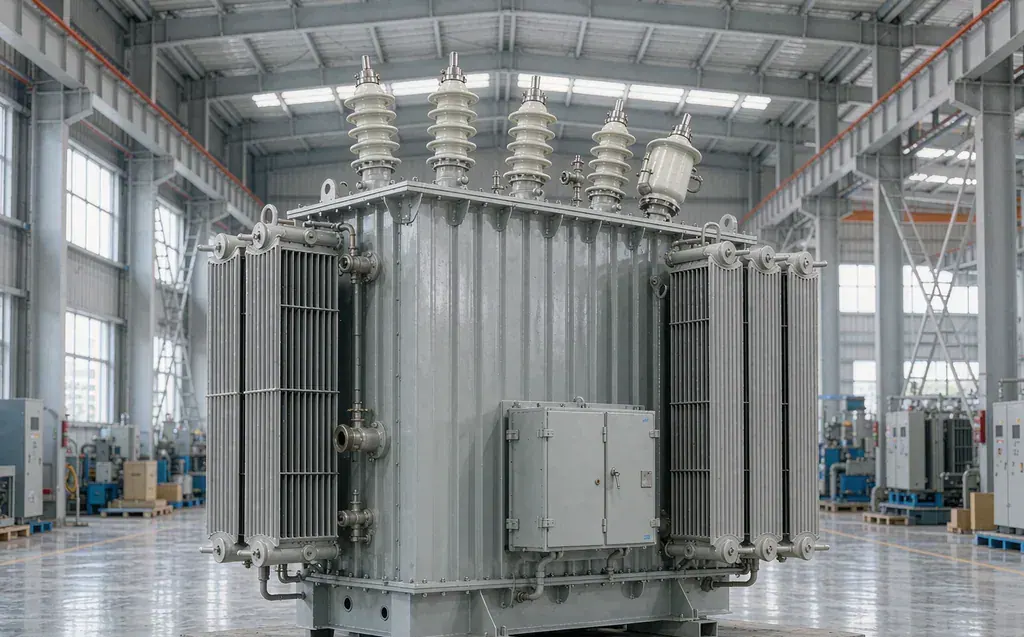
An ABB transformer reference — a line on a single-line diagram, a nameplate photo, or a model carried over from an earlier project phase — is one of the most common starting points we get from overseas EPC and industrial buyers. The question behind it is always the same: can a Chinese manufacturer’s unit genuinely substitute this one, or would we be swapping a known quantity for a lookalike? The honest answer depends far less on the name on the plate than on about a dozen parameters buried in the type designation and the rating plate. What follows is how to read those parameters, which of them actually constrain interchangeability, and where a substitution stops being defensible.
Reading the ABB reference and the rating plate
An ABB transformer rating plate is a structured document, and the type designation is its compressed index. Both are defined by IEC 60076-1 for power transformers and IEC 60076-11 for dry-type units, which is why a plate from any reputable maker carries broadly the same fields.
The type designation is a string that typically sequences a type or series marker, the rated power, the HV voltage class, the cooling class, and often a tap-change or application code. It is useful for identifying the family, but it is not a specification. Manufacturers abbreviate differently, and the same letters can mean different things across product lines. Treat the rating plate, not the type code, as the source of truth.
Read the plate in a fixed order. First the electrical identity: rated power in kVA or MVA, rated HV and LV voltages, rated currents, and the vector group with its phase displacement (Dyn11 is the common distribution-group example). Next the electrical performance: short-circuit impedance voltage expressed as a percentage, no-load loss, load loss, and the tapping range. Then the thermal and dielectric design: cooling class, temperature rise, and the insulation levels expressed as a lightning-impulse level paired with a power-frequency withstand level, the LI/AC convention. Finally the physical data: mass, oil mass for liquid-filled units, overall dimensions, and the type of insulating liquid.
Each field constrains a different part of the problem. Rated power and impedance voltage govern how the unit behaves in the network. Vector group decides what it can be paralleled with. Losses set running cost and heat load. Cooling class decides whether you are buying radiators, fans, or oil pumps. Insulation level sets dielectric clearances and bushing class. Mass and dimensions set the logistics and the civil works. The type designation gets you to a family; the rating plate gets you to a purchase order.
Mapping the parameters that actually constrain interchangeability
Not every field on a plate is a hard constraint, and the ones that are rarely sit where buyers expect. The table below separates the parameters that decide whether a Chinese unit can substitute from the ones that merely describe the ABB original. The third column is the test that matters — it is what we compare line by line.
| Parameter | What to read | What must match |
|---|---|---|
| Rated power | kVA or MVA on the plate | Match the rating, and confirm the basis (ONAN or ONAF) it is quoted at, since the same frame can carry a higher rating with forced cooling |
| Rated voltages and tapping | HV and LV rated voltages plus the tap range | Nominal voltages must match the system, and the tapping range must cover your actual operating band, not just the nominal ratio |
| Vector group | Group symbol and phase displacement, e.g. Dyn11 | Must match exactly if the unit is to run in parallel or to suit protection and phase-displacement requirements |
| Impedance voltage | Short-circuit impedance as a percentage | Must fall within the tolerance the network design and protection co-ordination assume; this is a constraint, not a preference |
| No-load and load loss | Both loss figures in kW | Must be verified against the values your tender or operating-cost model expects, not simply asserted on a datasheet |
| Cooling class | ONAN, ONAF, OF, or a combination | Must suit the duty cycle, ambient, and the physical provision for radiators, fans, or pumps at site |
| Insulation level and temperature rise | LI/AC levels and temperature-rise limits | Must meet the system insulation level and the specified winding and oil temperature-rise limits for the ambient assumed |
Two points are worth stating plainly. Losses are the parameter buyers under-weight and the one that most often moves price — a manufacturer can hit the headline kVA and voltage while quietly carrying higher no-load loss. Impedance voltage is not a target to approximate; it is a constraint. Parallel operation and downstream protection co-ordination both assume it, and a unit that deviates from the specified value can create circulating currents between paralleled transformers or shift fault levels. Most other fields can be met from a manufacturer’s standard range; these two usually decide the deal.
Where the equivalence breaks down
A matched nameplate is necessary but not sufficient. These are the places where a genuine equivalent still fails, and they are almost never printed on the rating plate.
- Accessories and fittings. Bushings and their arrangement, whether the LV side is a bare terminal or an enclosure, oil conservator versus sealed tank, Buchholz relay, pressure-relief device, winding and oil temperature indicators, and whether the tap changer is off-circuit or on-load. These are frequently the real barrier, because they are house-specific even when the core design is standard.
- Interface and space envelope. Footprint, overall height, bushing positions, cable-box entry direction, neutral arrangement, and anchorage or seismic provisions. A unit can be electrically equivalent and still not fit the bay, the foundation, or the crane envelope at site.
- Certificate scope. A certificate follows a specific design and a specific factory, not a brand. A type-test report for one rating does not transfer to another. For a substitute, confirm which routine and type tests apply, who witnesses them, and whether the third-party scope covers the unit you are actually buying.
- Spares and after-sales reality. A transformer is a twenty-to-thirty-year asset. Bushings, gaskets, tap-changer components, and oil-testing support need a supply line that outlives the warranty. For a critical unit, a cheaper machine with no local spares or service capability is a false economy.
- Test witness and documentation. Factory acceptance test attendance, routine tests to IEC 60076, type-test evidence, calculation reports, and O&M manuals in your operating language. If documentation matters to your client or your utility, it has to be in scope from the start rather than negotiated after the order.
Keep it or switch it
If any of the following holds, keeping ABB is the lower-risk call. The unit is a like-for-like replacement in an installation where it will run in parallel with existing transformers and the impedance voltage and vector group must be matched within a tight band. The project sits in a regulated environment where the utility’s approved-vendor list governs what may be connected. Or the transformer is a single point of failure with no realistic outage window and no local service capability.
If instead the transformer is specified by parameters rather than by brand — a new-build project or an expansion where it is not paralleled with existing units — and you can attend the tests and hold full documentation, an equivalent is defensible. The condition is not that the maker is Chinese. It is that the parameters are matched line by line, the losses are verified rather than asserted, and the certificate scope covers the exact rating you are buying.
The grey zone is the retrofit: an existing substation with fixed dimensions and connections but moderate electrical requirements. There the decision usually turns on the space envelope and the accessories, not the core. If the physical interface can be reproduced, the electrical match is normally achievable; if it cannot, no amount of loss matching will help.
SpecSourcing runs a free 48-hour screen that returns a go / hold / walk signal on one supplier for the unit you have in mind. For buyers who want the full picture, the paid Spec Match tier reverse-engineers the ABB reference into target parameters and shortlists Chinese manufacturers whose standard range genuinely covers them.
Common questions
Can a Chinese transformer really replace an ABB unit of the same rating?
Which single parameter is most often mismatched?
Is a cheaper equivalent a false economy?
Brand and model names are trademarks of their respective owners, used here for identification only. SpecSourcing is not affiliated with, authorised by, or endorsed by any of these manufacturers.