

HV switchgear / GIS
110-220 kV gas-insulated switchgear or AIS bays for transmission projects. Busbar rating, breaking capacity and SF6/N2 gas management are confirmed against the type-test and FAT records.
InquireThe Switchgear & Panels we reverse-engineer, verify, and negotiate on your behalf. Pick a model or send us the spec.
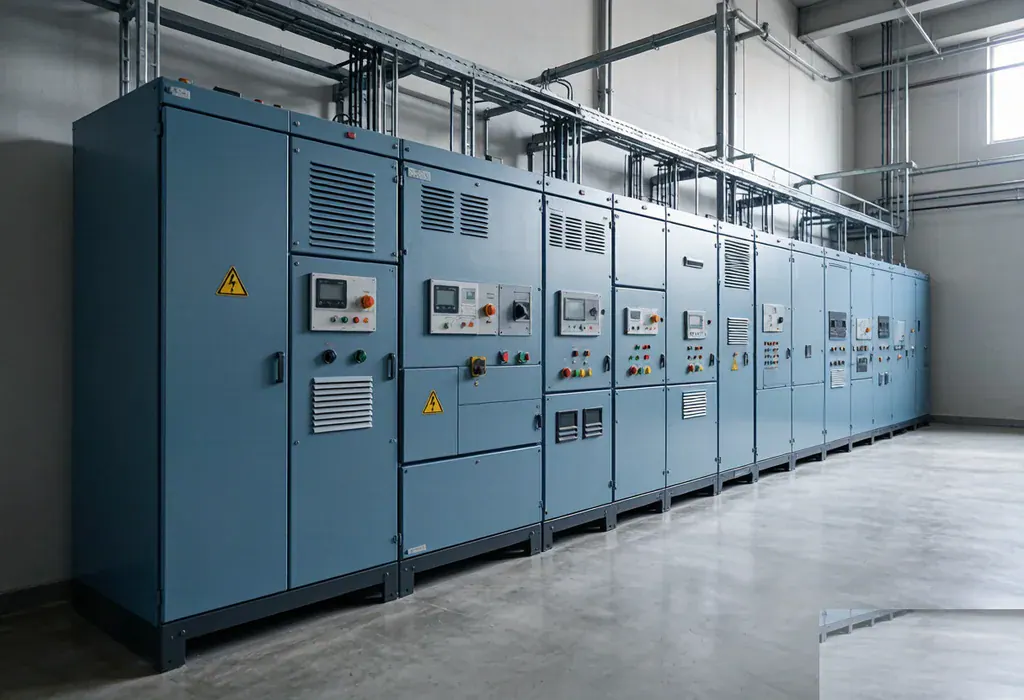
110-220 kV gas-insulated switchgear or AIS bays for transmission projects. Busbar rating, breaking capacity and SF6/N2 gas management are confirmed against the type-test and FAT records.
InquireAir-insulated or SF6-insulated panels, 12-40.5 kV, fixed or withdrawable. We confirm the type-test certificate matches the exact model and voltage class you are buying.
InquireMNS/GCS-style fixed or withdrawable panels up to 4000 A. Busbar material, IP rating, and short-circuit withstand are verified against the type test.
InquireCompact SF6 or solid-insulated RMUs for 12/24 kV distribution networks. Switching duty, cable entries, and gas type are confirmed against the datasheet and factory records.
InquireSubstituting MV metal-enclosed switchgear turns on five fields: rated voltage and busbar current, short-time and peak withstand under IEC 62271-200, internal-arc classification (IAC — bound to the enclosure construction, not an accessory), platform commonality (the "same manufacturer" claim can sit across different breaker platforms), and the completion of interlocking duty.
The highest-yield line in verification is the **scope line** of the test report: whether the certificate names the 24 kV or the 36 kV design, whether the temperature-rise test ran at the current your order requires, and whether the internal-arc report covers your arrangement. One report covers one configuration; a hurried reviewer stops at the word "certified" and misses the entire story.
The workflow mirrors the rest of the site: a free 48-hour screen returns a go / hold / walk signal on one supplier; the Spec Match tier reverse-engineers parameters and shortlists factories whose product line covers them; the Remote Audit verifies tooling, interlocks and test records on the floor. You pay us, and no commission flows from any factory, stated in writing.
China carries the bulk of world output in MV and LV assemblies, and that output is concentrated in a handful of clusters. Finding a factory is therefore a fairly specific geographical question.
The low-voltage electrical cluster centred on Yueqing, Zhejiang, gathers more than 14,000 firms across the electrical chain, covering some 200 product series, 6,000 categories and 25,000 models, with a local supply rate around 85% and a one-hour delivery loop. Enclosures, breakers, busbars and secondary components can be assembled within a day.
The same cluster posted around RMB 124.6 billion in above-scale industrial output in 2024, and low-voltage electrical products from it hold over 65% of the domestic Chinese market. One drawing can be quoted by several factories at once — exactly the competition a buyer wants.
A high local supply rate also means many sub-contract steps. Internal-arc classification rests on the complete enclosure construction, so one sheet-metal operation sent out of the controlled line can invalidate the rating; and the anti-corrosion class (C4/C5) is the line quotations quietly downgrade most often.
Whether the report names a 24 kV or a 36 kV design, whether the temperature-rise test ran at your ordered current, and whether the internal-arc report covers your cubicle arrangement. One report covers one configuration — a hurried reviewer stops at the word "certified".
The single-line diagram, the cubicle schedule or just the rating and IP class is enough to start. We return one verdict on the supplier and one core reason within 48 hours, then map the parameters onto a shortlist of factories whose product line genuinely covers them.
Independent · No kickbacks · Files that audit
Submit one supplier and get a free go / hold / walk read, no commitment, no sales call.
Written quote within 24 hours